Online advertising has changed dramatically over the last few years. Static banners and traditional display ads once dominated websites, apps, and digital campaigns because simply appearing in front of users was enough to generate clicks. But the internet does not work that way anymore. Audiences scroll faster, attention spans are shorter, and users instinctively ignore anything that feels repetitive or overly promotional. This shift is exactly why rich media ads have become one of the most important tools in modern marketing.
Today’s consumers expect movement, interaction, and experiences rather than flat advertising visuals. A static banner sitting quietly on a webpage rarely creates enough curiosity to stop someone mid-scroll. Rich media changes that completely by transforming ordinary advertising into interactive, immersive, and visually engaging ads.
Instead of simply asking users to “click here,” modern rich-media advertising encourages them to interact, swipe, expand, explore, watch, or engage directly with the ad. And that shift from passive viewing to active participation is what makes rich media so effective in today’s crowded digital space.
What Are Rich Media Ads?
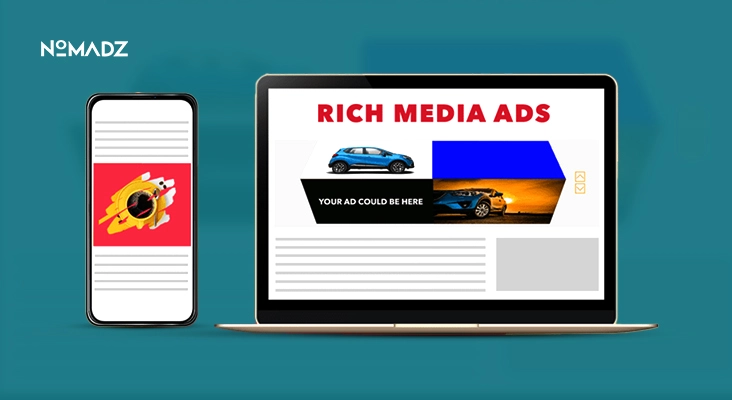
Fundamentally, rich media advertisements are high-tech digital ads that incorporate interactive features, as opposed to traditional image- or text-based banners. These advertisements may include animation, video, audio, expandable formats, interactive galleries, gamified experiences, or clickable product displays that will react to user actions in real time.
The experience is what makes rich media different from standard display ads. Traditional advertisements are meant to be seen, whereas rich media are meant to be played with. It is important because today, internet users are much more likely to engage with dynamic rather than static content.
For example, a fashion brand can incorporate a swipeable product carousel, enabling them to browse the entire product range in the ad. A beauty brand can develop an interactive shade finder, and a travel company can offer an immersive video experience, so destinations can be presented without requiring users to scroll to the landing page.
The goal is no longer just visibility. Brands now compete for engagement, attention, and memory retention, and rich media ads help accomplish all three at once.
Why Rich Media Advertising Performs Better?
Rich media advertising works so well for one reason: people are sick and tired of the same ads. Decades of banner repetition have conditioned internet users to be blind to permanent placements, a phenomenon sometimes termed “banner blindness” by marketers.
Rich media is an inherent disruptor of that trend, since movement is instantly noticeable. Users’ focus does not shift to the animation, interaction, or immersive visuals; instead, it remains on the experience itself. The commercial does not seem like an intrusion but rather a piece to be read.
Such a psychological difference drastically alters campaign performance.
| Traditional Display Ads | Rich Media Ads |
| Static visuals | Interactive experiences |
| Passive viewing | Active engagement |
| Limited storytelling | Dynamic storytelling |
| Short attention span | Longer engagement time |
| Basic click-through actions | Multiple interaction points |
Because brands spend more time with the creative itself, they tend to achieve higher click-through rates, increased engagement, and higher conversion rates than in traditional digital display advertising campaigns.
Rich media works because it aligns with how people already consume content online – visually, interactively, and quickly.
Also Read: How to create Rich Media Ads?
Interactive Ads Feel More Natural Online
One reason interactive ads continue to grow so rapidly is that they feel more natural in today’s internet culture. Modern users are already conditioned to swipe, tap, scroll, expand, and interact constantly across social media platforms, ecommerce sites, and mobile apps.
Rich media is just a reflection of such behaviors within advertising itself.
As soon as users can hover over a product, interact with a video, or navigate a carousel without leaving the page, the ad experience will be less disruptive and smoother. The advertisement does not capture its attention; rather, it draws it in through involvement.
This is also why the majority of brands are shifting to engaging ads rather than overselling promotional creatives. Consumers are becoming more sensitive to experiences that are entertaining and visually engaging, rather than advertisements that explicitly require conversion.
Emotional involvement is important, as the likelihood of people retaining the brands they engage with is much higher than for those they view only while scrolling.
Video Ads Are Driving the Rich Media Boom
The future of online advertising has been entirely transformed by short-form video content. The launch of apps such as TikTok, Instagram Reels, and YouTube Shorts, as well as streaming services, has changed how people consume content, and video ads are considered among the most effective ad formats in the online space.
Video naturally captures attention more quickly because movement interrupts scrolling. But rich media takes video advertising much further by adding interaction directly into the viewing experience.
Instead of simply watching a product demonstration, users may:
- Click on products inside the video,
- explore interactive overlays,
- expand additional information,
- or navigate through multiple scenes.
That level of participation transforms ordinary video campaigns into immersive brand experiences.
| Standard Video Ads | Rich Media Video Ads |
| Passive watching | Interactive participation |
| Linear viewing | User-controlled interaction |
| Basic storytelling | Immersive experiences |
| Limited engagement | Higher interaction rates |
Consumers today no longer just passively consume content. They anticipate interacting with it, customizing it, and communicating with it. Rich media succeeds because it does not fight that behavior; rather, it tailors advertising to it.
Why Rich Media Ads Convert Better?
It is not sufficient to engage without campaigns that result in action. The bottom line is that brands are focused on conversions, customer behavior, and quantifiable business outcomes, and thus, more and more high-converting ads are based on rich media ad formats.
Rich media campaigns minimize customer-journey friction by helping users explore products and services before they abandon the advertisement. Users do not have to blindly click on a landing page; they already know the features, images, advantages, and product experience, and they take action.
For e-commerce brands, this can take the form of expandable product galleries, virtual try-on, or interactive shopping ads. Also, for SaaS businesses, this can be achieved through interactive product demonstrations. For automotive companies, it might be a 360-degree visual experience.
In both scenarios, the advertisement is part of the buying experience rather than a bridge to another page.
That conversion enhances user confidence, improves engagement quality, and often results in better conversion performance across campaigns.
Also Read: Shoppable Rich Media Ads: Turning Engagement into Sales
Rich Media Banners Are Changing Display Advertising
Over the years, marketers have been frustrated by the constraints of traditional banner advertising, as users have become very proficient at ignoring static placements. Rich media banners address this issue by incorporating animation, movement, and interactivity, which automatically help them stand out in the congested online space.
These banners are not flat and repetitive; they feel visually alive. The use of expandable creatives, animated product showcases, hover-enabled effects, and interactive experiences embedded in banners helps make otherwise dull banners more noticeable.
This development is significant because display advertisements remain a major part of online advertising. Display advertising is not overtaken by rich media; rather, it is enhanced to make the experience more interactive, visually dynamic, and harder to disregard.
With the internet overloaded with content, brands that offer a more immersive visual advertising experience have a strong competitive edge.
The Future of Rich Media Advertising
Advertising is also becoming more interactive, with brands experimenting with AI-driven personalization, gamified creative, AR shopping experiences, and adaptive campaigns that respond dynamically to user behavior.
The boundary between advertising and entertainment is unclear, as audiences seek more digital experiences that are non-interruptive yet interactive. Attention-seeking ads are no longer interesting to consumers. They are far more receptive to advertising that is visually appealing, emotionally involving, or actually useful.
That is why other industries, such as e-commerce, gaming, fashion, entertainment, and technology, still invest heavily in rich-media strategies. The brands getting attention online today are not always the noisiest, but the ones that create experiences people want to be part of.
As user behavior continues to evolve, the importance of rich media ads will grow alongside it.
Conclusion
Modern advertising is no longer just about visibility. Consumers already see thousands of ads every day, so attention alone is no longer enough to make an impact. Brands now compete through interaction, engagement, and experience.
That is exactly why rich media ads have become so powerful in modern digital display advertising. Whether through immersive video ads, expandable rich media banners, or highly interactive ads, rich media transforms advertising from something users ignore into something they actively experience.
And in an internet economy driven by attention, the ads people remember are almost always the ads they interacted with the most.
Frequently Asked Questions
Common rich media formats include expandable banners, interactive videos, animated creatives, swipeable carousels, playable ads, and audio-enabled advertisements designed to increase engagement.
Interactive advertisements are more effective because they involve users in activities rather than passively consuming information. This builds greater engagement, attention retention, and enhanced brand recall.
Rich media campaigns enhance conversions because users can explore products, interact with features, and learn about the brand experience before clicking through, which generates greater purchase intent.
Yes. Most modern rich media ads are optimized for mobile users and are designed to work smoothly across smartphones, tablets, apps, and responsive websites.
Industries such as e-commerce, fashion, gaming, entertainment, travel, and technology benefit greatly from rich media ads, as interactive experiences help showcase products and services more effectively.