
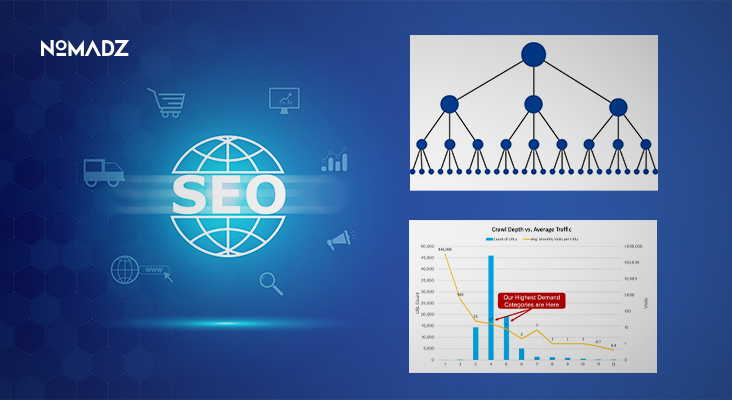
When we talk about SEO, most conversations revolve around keywords, content quality, and backlinks. However, in the background, there are technical reasons why your pages are even allowed to have a chance to rank. Crawl Depth is also one of the most significant yet underestimated factors.
When search engines fail to find your valuable pages, then the rankings will be affected- regardless of the effectiveness of your content. Here, we are going to dissect this depth into easy-to-understand terms in this blog, explain why it is important, and how to maximize it to achieve greater SEO performance.
What is crawl depth?
Crawl Depth is the number of clicks it takes the search engine crawler to reach a particular page, starting with the home page.
For example:
Homepage/Blog/Category/Article
This page has a crawl depth of 3.
The harder a page is, the harder it is to search, crawl, and rank, according to the search engines. Too-long pages receive less crawl and worse SEO indicators.
And this is the reason why it is such a significant aspect of technical SEO.
Also Read: What is page load time & How to optimize it for better page speed?
Why does crawl depth matter for SEO?
Not all the pages are crawled by the search engines. They limit the number of crawl budget they give to a particular site, which implies that they focus on pages that are easily accessible.
When crawl depth is optimized:
- Important pages get crawled more often
- Indexing happens faster
- Internal link equity flows better
- Rankings improve naturally
On the other hand, excessive of this depth can cause high-value pages to remain under-indexed or ignored.
What is the ideal crawl depth?
No concrete rule exists, but according to the best practices of SEO, key pages should be reachable within three clicks or fewer using the homepage.
Here’s how this depth generally performs:
- Depth 1-2: Excellent for SEO
- Depth 3: Acceptable
- Depth 4 or more: Risky for visibility
Deep crawl depth should not be maintained as it increases crawlability and user experience.
Common reasons why websites have poor crawl depth
Deep structures that damage SEO are created in many websites unwillingly.
Some of the most frequent causes are:
- Too many nested categories
- Weak or missing internal links
- Orphan pages with no links
- Heavy pagination
- JavaScript-dependent navigation
Identifying these issues is the first step toward fixing problems related to this depth.
How does crawl depth impact crawl budget?
Crawl budget is the number of pages search engines are willing to crawl on your site within a given timeframe.
If your website has:
- Deep URLs
- Duplicate pages
- Low-value links
Search engines can also utilize crawl budget before visiting crucial pages. Crawling Depth Optimization is the priority of your crawling to make sure that crawlers are visiting your actual priority content and not working around the layers that are not important to you.
How to check crawl depth on your website?
You can analyze this depth using site audit tools that crawl your website like a search engine.
When reviewing reports, focus on:
- Pages deeper than four levels
- Important pages with high crawl depth
- Pages receiving little internal link support
These insights help you decide which pages need optimization first.
How to optimize crawl depth for better SEO?
Improve internal linking (Most effective method)
Internal linking is one of the fastest ways to reduce this depth.
Best practices include:
- Linking key pages directly from the homepage
- Adding contextual links within blog content
- Using descriptive anchor text
Strategic internal linking shortens crawl paths and improves page authority.
Simplify your website structure
A flat and logical structure helps both users and crawlers.
Instead of:
Homepage → Category → Subcategory → Sub-subcategory → Page
Aim for:
Homepage → Category → Page
Reducing unnecessary layers directly improves crawl efficiency and depth.
Also Read: How to improve your Website Engagement Rate (Tips & Strategies)
Use breadcrumb navigation
Breadcrumbs provide additional internal links and help search engines understand hierarchy.
Benefits include:
- Reduction of this depth
- Better internal linking
- Improved user navigation
Breadcrumbs are especially useful for large websites and e-commerce platforms.
Optimize navigation menus
Your main navigation should highlight your most important pages.
Avoid:
- Hiding key pages deep inside dropdowns
- Linking low-priority pages from primary menus
Clear navigation keeps this depth shallow and also improves flow.
Fix Orphan Pages
Orphan pages have no internal links pointing to them, making them difficult to crawl.
To fix them:
- Add links from relevant content
- Include them in category or hub pages
- Reference them in navigation where appropriate
Fixing orphan pages significantly improves this depth and indexation.
Crawl depth optimization techniques overview
| Technique | SEO Benefit |
| Internal linking | Shortens crawl paths |
| Flat architecture | Faster crawling |
| Breadcrumbs | Stronger hierarchy signals |
| HTML sitemap | Easier discovery |
| Removing redirect chains | Cleaner crawl routes |
Crawl depth and site architecture
It is a direct result of the site architecture. A poorly planned structure creates deep URLs and crawl inefficiencies.
A strong architecture:
- Keeps this depth under control
- Improves crawl budget usage
- Enhances user experience
This makes architecture optimization a long-term SEO investment.
Managing crawl depth for large websites
Large websites naturally face this depth challenge due to scale.
Effective strategies include:
- Creating hub pages
- Prioritizing category-level linking
- Using HTML sitemaps
- Strengthening internal linking automation
Even small improvements in this depth can lead to noticeable SEO gains for large sites.
Also Read: How to improve Brand Visibility in AI Search Engines?
Mistakes that increase this depth
Some SEO practices unintentionally hurt crawlability:
- Excessive pagination without linking
- Overuse of filters creates deep URLs
- Blocking internal links with JavaScript
Avoiding these mistakes helps maintain healthy crawl depth.
Conclusion
Crawl Depth is not visible on the surface, but it is very strong in the success of SEO. The easier the search engines can reach the pages in your site that are the most valuable, the better the indexing is enhanced, authority is generated, and the rankings come in.
Through the simplification of the structure, internal-linking, and/or repair of deep or orphaned pages, one can effectively optimize this depth and create a website where users and search engines are equally pleased to know its existence.
FAQs
What is crawl depth in SEO?
This depth measures how many clicks it takes for a crawler to reach a page from the homepage.
Why is crawl depth important?
It affects crawl frequency, indexing speed, and search visibility.
What is a good crawl depth?
Important pages should ideally be within three clicks of the homepage.
How do internal links affect this depth?
Strong internal linking reduces depth and improves crawl efficiency.
Does this depth affect rankings directly?
Indirectly, yes – deep pages are crawled less and may rank lower.