

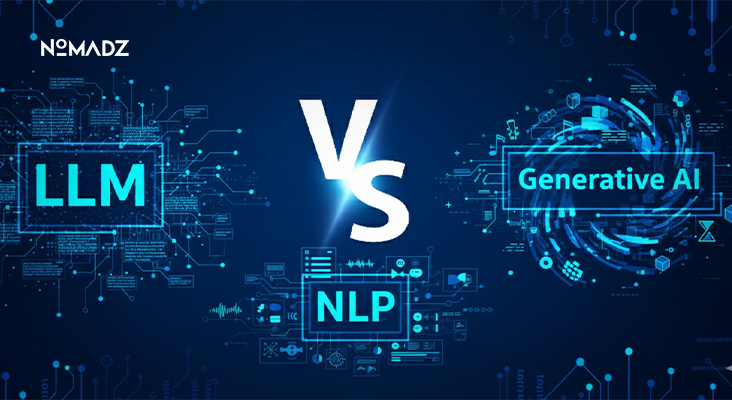
LLM vs Generative AI vs NLP: A Complete Guide
Language-related artificial intelligence technologies have changed how machines perceive and communicate with us in the world of artificial intelligence. The creation of rule-based systems has been transformed into powerful models capable of producing original content. Nowadays, one might often hear such terms as LLM vs Generative AI vs NLP, yet they do not necessarily imply one another. To know more about the history, definition, distinctions, and applications of these technologies in reality, continue reading.
Historical Context: From Language Rules to Creative AI
Artificial intelligence began with basic tasks, like classification and prediction. Early systems couldn’t really understand complex language. In due course, scientists discovered that meaningful communication between humans and computers required machines to understand language patterns.
To meet this requirement, Natural Language Processing (NLP) came into existence. Over the decades, NLP transformed from rule-based parsing to statistical and machine-learning solutions, which were able to process and analyze text and speech.
Later, developers began building models that didn’t just understand language; they could generate it. Large Language Models (LLMs) like GPT and BERT were born, trained on huge text corpora to make contextual predictions and produce fluent text.
Today, Generative AI expands the horizon even further. Not only is it not limited to language, but to any type of content, i.e., images, music, video, and more, thus the question is not one of competition but position and ability of LLM vs Generative AI vs NLP.
Also Read: What is LLM – Everything you need to know about LLM & its working
Understanding Generative AI, LLMs, and NLP
Natural Language Processing (NLP): The Foundation
The arm of AI that allows machines to comprehend the language of humans in systematic ways is referred to as NLP. It converts unstructured text into a machine-readable format – sentiment analysis, entity extraction, and information classification.
NLP plays a significant role in search engines, translation tools, speech recognition, and content analysis environments. It does not necessarily produce creative work; it generally tends to interpret it.
The difference between NLP and LLM is rooted in this: NLP is concerned with interpretation, whereas LLMs are based on it to generate language.
Large Language Models (LLMs): The Evolution
LLMs are advanced AI models designed to understand and generate language at scale. They use deep learning and enormous datasets to learn how words and sentences relate.
The outstanding characteristic of LLMs is that they do not solely work through text, but they can also generate sensible and contextually aware answers. The previous mentions of LLM are sure to have crossed your life whenever you have been using an essay writing, summary writing, or question answering tool.
In the debate of LLM vs NLP, an LLM can be thought of as NLP’s “next level”; it includes understanding and generation, not just interpretation.
Generative AI: The Creative Apex
Generative AI refers to any AI capable of creating new content. This includes text, but also images, music, and even 3D models. Models like GANs (Generative Adversarial Networks) and diffusion models are examples of generative AI technologies used in art and media creation.
LLMs are a subset of generative AI that focus specifically on language. Speaking of LLM vs generative AI, the line between the two is rather evident: all generative AI models can be discussed as LLMs, but not all generative AI models are LLMs. Others are visual or audio-based, rather than text-based.
This broader capability makes Generative AI the bigger category, with LLMs nested inside it and NLP as a foundational layer.
Differences and Overlaps: LLM vs Generative AI vs NLP
Understanding LLM vs Generative AI vs NLP is easier when you see them as parts of a spectrum in AI:
- NLP helps machines understand language.
- LLMs help machines understand and generate language.
- Generative AI helps machines create new content, including text, images, and more.
NLP and LLMs are similar in terms of their functions. The analogy NLP vs LLM actually explains a development: NLP made the language understanding, and LLMs added the creative output to it.
Meanwhile, in LLM vs generative AI, LLMs represent the language generation corner of a much larger creative field.
Applications Across Industries
NLP in Use
From spelling correction to sentiment analysis, NLP is used in search tools, assistants, and analytics platforms. It helps interpret user intent and extract meaning from text and voice.
LLMs in Use
LLMs power advanced chatbots, automated writing tools, code assistants, and contextual search. They’re transforming customer support, content marketing, and research workflows.
Generative AI in Use
In addition to text, Generative AI produces art, music, aids in product design, and even assists in the field of scientific investigation by synthesizing creative products of different forms.
These applications allow understanding that LLM vs Generative AI vs NLP is used to clarify where each technology is being the brightest.
The Future of Generative AI, LLMs, and NLP
These technologies are promising for the future. NLP will keep being enhanced to establish the understanding of nuances in language by machines. The LLMs will be more sensitive, moral, and individualistic. Generative AI will push boundaries of its creativity, and machines will be able to be creative with people.
No matter the changes in technology, knowledge of the differences between the classification: LLM versus generative AI, NLP versus LLM, and LLM versus NLP will be of great significance to businesses and developers with AI strategy plans.
Also Read: AI Overviews: What is AI Overview and How to Optimize for Them
Conclusion
LLM vs Generative AI vs NLP is not a competition. Instead, it’s a story of progression:
- NLP laid the foundation of language intelligence.
- LLMs expanded on that to include generation.
- Multimodal creativity was expanded by generative AI.
In this way, when you use these technologies, you can more easily decide on the appropriate tools and strategies to use in your projects because you know how these technologies work together. Clarity on the LLM vs Generative AI vs NLP is the difference between success and failure, whether you are building chatbots or content tools, or engaging AI applications.
FAQs
Is NLP part of Generative AI?
No, NLP focuses on language understanding, while Generative AI includes content creation across many formats.
Are all LLMs generative AI?
Yes, every LLM is a type of generative AI that focuses on text generation.
What’s the difference between NLP vs LLM?
NLP interprets language; LLMs interpret and generate language.
Why is LLM vs generative AI important?
It helps clarify that generative AI includes more than just text; LLMs are focused on language, while other models might generate images, music, or video.
How do these technologies work together?
Generative AI is frequently used in text tasks based on the use of LLM, whereas NLP methods can be used in either case, developing systems that are powerful in understanding and creativity.



Leave feedback about this