

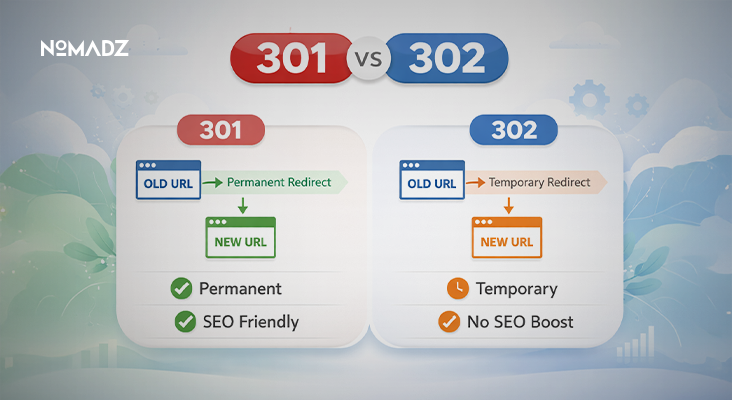
What is 301 Redirection? (301 vs 302 Explained)
Redirects are one of those behind-the-scenes in the world of SEO and managing a website that will silently influence performance. When properly implemented, users are always unaware of them. When poorly done, they may cause broken links, lost rankings, and misdirected search engines. The 301 Redirection is the most significant of all redirects.
By 2026, the search engines have become even more intelligent, yet they will be based on transparent technical indicators. This is the reason why the knowledge of 301 vs 302 Redirection is necessary to the person in charge of a site; it can be a business site, blog, or large-scale site.
This blog simply describes, in clear words, what is meant by 301 redirection and how it is different from 302 redirects, and how to know when and how to use both redirections properly.
What is 301 Redirection?
301 Redirection is an irreversible redirect that informs the search engines and users that a webpage has moved permanently under a different URL. When this has been implemented, all attempts to open the old URL redirect to the new one.
This is essential in terms of SEO since a 301 redirect is an indication that:
- The old page is no longer the primary version
- The new page should inherit its authority
- Search engines should update their index
This is why 301 Redirection is widely used during website migrations, URL restructuring, and long-term content changes.
Also Read: What is page load time & How to optimize it for better page speed?
Why 301 Redirection matters for SEO in 2026?
The search engines of 2026 are intent-oriented, search efficient, and user-friendly. Redirect enables search engines to know how your site changes over time.
An adequate 301 Redirection:
- Preserves organic rankings
- Passes most link equity to the new URL
- Prevents users from landing on broken pages
- Helps search engines search through your site
Correct redirects are needed even to make good content visible.
When is 301 Redirection typically used?
301 redirects are used when a URL change is permanent. Some of the most common scenarios include:
- Website redesigns where URLs are updated
- Domain changes or brand migrations
- Switching from HTTP to HTTPS
- Merging similar or duplicate pages
- Removing outdated pages with backlinks
In all these cases, 301 Redirection ensures that users and search engines are guided smoothly to the correct page.
How does 301 Redirection work behind the scenes?
Technically, a 301 redirect includes an HTTP status code, which notifies the web browsers and crawlers that the resource has undergone a permanent change. The browsers lead the users to the new address automatically, and the search engines are slow in updating their databases.
SEO-Wise 301 Redirection assists search engines:
- Replace the old URL with the new one in search results
- Transfer ranking signals
- Reduce crawl errors
- Understand site structure changes
This process may take time, but the signal itself is clear and reliable.
301 vs 302 Redirection: Understanding the core difference
The major distinction between Redirection 301 vs 302 is the intent. A 301 redirection means a permanent change, and a 302 redirection is a temporary change.
Here’s a clear comparison:
| Factor | 301 Redirection | 302 Redirection |
| Nature of Redirect | Permanent | Temporary |
| SEO Value Transfer | Yes, mostly passed | Usually not passed |
| Indexing Behavior | New URL replaces old | Old URL remains indexed |
| Ideal Use Case | Long-term changes | Short-term testing or maintenance |
Choosing the wrong option in the 301 vs 302 Redirection decision can confuse search engines and weaken SEO signals.
Also Read: How to improve your Website Engagement Rate (Tips & Strategies)
When should you use 301 instead of 302?
Apply 301 Redirection in the event that you are sure the original URL is not going to respond. This applies to domain migrations, URL cleanups, and content consolidation.
In such cases, indexing can be slowed down with the use of a 302 redirect, and the search engine will continue to rank the incorrect URL. This is why it is important to learn 301 vs 302 Redirection in the long-term maintenance of SEO.
When is 302 Redirection the right choice?
302 redirects still have a place in modern SEO, but only for temporary situations. These include:
- Short-term maintenance pages
- A/B testing landing pages
- Seasonal campaigns
- Temporary content changes
Once the temporary phase ends, the redirect should be removed or replaced with a 301 Redirection if the change becomes permanent.
SEO impact of 301 Redirection in 2026
In 2026, search engines process redirects efficiently, but errors still matter. Clean redirect implementation helps maintain authority and user trust.
Correct 301 Redirection supports:
- Stable keyword rankings
- Smooth user journeys
- Reduced 404 errors
- Better crawl budget usage
However, issues like redirect chains, loops, or irrelevant redirects can negatively impact performance.
Best practices for using 301 Redirection
To ensure your redirects work as intended, follow these best practices:
- Redirect each page to the most relevant alternative
- Avoid redirect chains (A → B → C)
- Update internal links after redirects are live
- Use server-side redirects whenever possible
- Monitor redirects using tools like Search Console
These steps make 301 Redirection more effective and search engine-friendly.
Common mistakes to avoid
Even experienced website owners make redirect mistakes. Some common ones include:
- Using 302 redirects for permanent changes
- Redirecting multiple pages to one generic page
- Forgetting to update internal links
- Creating redirect loops
- Ignoring HTTPS or mobile URL versions
Avoiding these mistakes ensures your 301 vs 302 Redirection strategy remains clean and effective.
Final thoughts
One of the strongest tools in technical SEO is 301 Redirection, which will continue being powerful in 2026. It is safe when it is applied in the right way, that it secures rankings, maintains authority, and offers a smooth user experience. The knowledge of the distinction between 301 and 302 Redirection can help you make better choices and prevent an expensive mistake in search engine optimization.
Redirects can be absent to the user, but they have a touch on search performance that is anything but benign.
FAQs
Does 301 Redirection pass SEO value?
Yes, the majority of equity goes over to the new URL.
What is the length of time Google takes to identify a 301 redirect?
The redirection of users happens immediately, whereas indexing changes take days or weeks.
Do 301 redirects have an impact on the speed of a site?
Very little effect when properly used, although too many chains will slow down the performance.
Canonical tags or 301 Redirection: which one is better?
They are not used to achieve the same purpose and are not expected to substitute one another.
Is 301 Redirection the best way to use deleted pages?
Yes, if the page had traffic or backlinks, redirecting preserves value.





Leave feedback about this